SEO Gets You Ranked. AIO Gets You Chosen. Here Is Why That Matters Now.
Gone are the days of relying solely on search engine rankings to be discovered online. Today, users increasingly receive answers directly from artificial intelligence (AI) systems through AI Overviews, voice interfaces and chat-based tools like ChatGPT. In many cases, users find what they need without visiting a website at all.
Relying solely on search engine rankings is no longer enough; visibility now depends on whether your brand is clear and credible enough to be used in AI-generated responses. This is where AI Optimization (AIO) comes in. AIO is the umbrella discipline for earning visibility across every AI-driven surface, and Generative Engine Optimization (GEO) is one of its core practices.
In this new landscape, “being cited” means an AI system names your brand, links to your site, or quotes your content when answering a user’s question. It is the AI-era equivalent of being recommended, and it determines whether your brand even enters the conversation when customers ask AI for help making decisions.
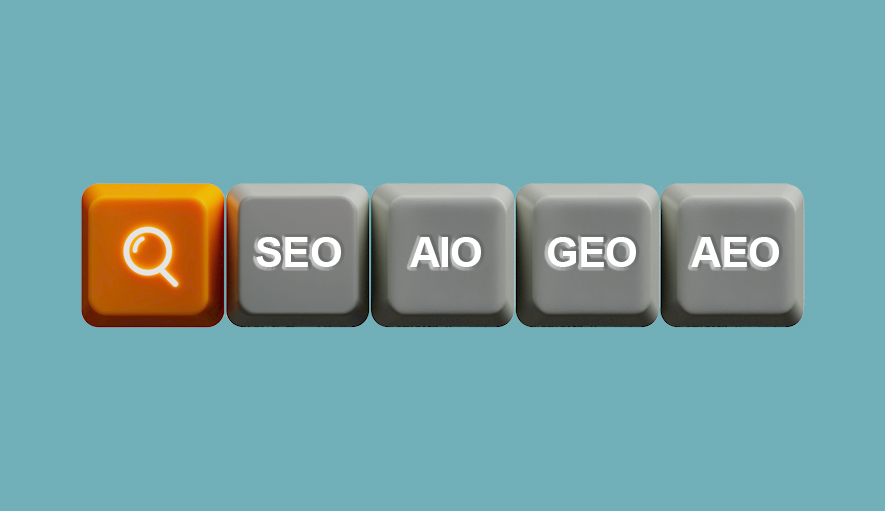
Understanding SEO, AIO, GEO and AEO
The vocabulary around AI search is still settling, and the acronyms are easy to confuse. Here is how the terms relate to one another:
- Search Engine Optimization (SEO) is the foundational practice of structuring a website so search engines can crawl, index and rank its pages. The goal is to earn organic placement in traditional results.
- AI Optimization (AIO) is the broadest of the AI-era disciplines. It is the strategic framework for making a brand discoverable, accurately represented and favorably positioned across every AI-driven system, from chatbots to AI Overviews. AIO encompasses how AI models understand a brand’s identity, sentiment and authority. Note that some practitioners use AIO as shorthand for Google’s AI Overviews specifically. Throughout this article, we use it in the broader sense.
- Generative Engine Optimization (GEO) is a core practice within AIO. GEO focuses specifically on earning citations and mentions inside the synthesized answers that generative tools produce, such as ChatGPT and Google Gemini. It is the most established and widely studied AIO practice.
- Answer Engine Optimization (AEO) is the process of optimizing your brand and content so it can be cited and recommended by AI-powered search and answer platforms, such as Google AI Overviews.
These practices work together rather than compete with one another. SEO helps search engines discover, understand and rank content. GEO focuses on earning citations and mentions in AI-generated responses. AEO helps brands appear in direct answers and recommendations across AI-powered search experiences. AIO brings these efforts together under one strategy. The sections that follow show how to create content that AI systems can find and reference.
AIO focuses on making site content consistent and trustworthy so it can be understood and reused across AI systems and contexts. GEO and AEO support this goal by helping AI systems identify trustworthy information and surface it in responses. According to academic research from Princeton, Georgia Tech, the Allen Institute for AI and IIT Delhi, GEO strategies can boost visibility by up to 40% within generative engine responses, with adding relevant statistics and citing credible sources ranking among the most effective tactics.
Popular AI systems include ChatGPT, Google Gemini, Microsoft Copilot, Meta AI, and Anthropic’s Claude, along with voice assistants like Siri and Alexa that increasingly draw from the same generative layer.
What Do SEO and AIO Have in Common?
While SEO and AIO operate differently, they share a common foundation.
- Both reward helpful, reliable, people-first content. Content that clearly answers real questions and demonstrates expertise is more likely to perform well in traditional search and to be referenced by AI systems. Google’s E-E-A-T framework, which evaluates Experience, Expertise, Authoritativeness and Trustworthiness, remains the connective tissue between strong SEO performance and strong AI citation rates.
- Both depend on technical accessibility. If a website cannot be crawled, rendered or understood by machines, it will struggle in search rankings and AI-generated answers.
- Both increasingly exist in zero-click environments. Users may get what they need from an AI Overview or response without ever visiting a website.
How Do SEO and AIO Differ in Practice?
SEO and AIO may share roots in site health and quality, but they differ in how information is absorbed and presented.
- SEO operates inside ranked systems. Search engines evaluate individual web pages, compare them against alternatives and decide which pages deserve to appear, and in what order. The outcome is a list of results, often supplemented by map packs, featured snippets and now, AI Overviews, but it is still based on search engines’ ranking logic.
- AIO operates inside generative systems. AI systems do not crawl and rank web pages in the same way search engines do. Instead, they evaluate information across many sources, extract relevant signals and synthesize a single response, which may or may not include citations. The outcome is a unified answer, rather than a list of choices.
Note: According to Google, its AI Overviews and AI Mode extract and synthesize content differently than traditional ranked listings. These elements require an AIO approach while occupying traditional search real estate.
How Are People Using AI?
In short, people are using AI to learn, work and play.
Awareness and adoption are accelerating quickly. Pew Research Center reports that 34% of U.S. adults have used ChatGPT, a figure that has roughly doubled since 2023, and 79% of Americans have heard at least a little about the platform. Among employed Americans, 28% have used it for work-related tasks, 26% use it to learn something new and 22% engage with it for entertainment.
Younger audiences are building AI momentum. Pew Research Center indicates that roughly two-thirds of American teens use chatbots, and about 3 in 10 engage with them daily. For this generation, conversational AI is becoming embedded in everyday routines.
As usage grows, so does influence. When someone consults ChatGPT or another AI system for a recommendation, explanation or comparison, the system determines which brands, facts and sources shape the response. Try this experiment: open ChatGPT and ask it to recommend the best agencies, restaurants or service providers in your category. The brands that appear consistently have invested in AIO. The ones that do not, no matter their traditional search rankings, are absent from the conversation entirely.
Creating Content That AI Systems Value
Instead of focusing on short, fragmented keywords, brands must write in a way that reflects how real people ask questions. AI systems respond to natural, conversational phrasing, whether typed or spoken. The way users frame their questions directly influences which sources are evaluated and which answers are delivered.
AI systems favor content that:
- Directly answers questions with clear claims
- Demonstrates subject matter expertise
- Uses structured formatting and logical hierarchies
- Maintains consistency across digital presence
- Is referenced or validated by third-party sources
In practice, this means leading a page or section with a clear, self-contained answer to the question it addresses, then supporting that answer with specific data and credible citations. Recent analysis of AI citations shows that the first 30% of a page’s text accounts for a disproportionate share of what generative systems extract, which makes the opening of every page a high-stakes decision. The Princeton-led research found that adding relevant statistics, incorporating credible quotations and citing sources were among the most effective ways to earn a place in AI-generated responses, so factual density throughout a piece, not just in a single data section, is what signals to AI systems that content is authoritative.
AIO-aligned content ensures brands remain visible wherever and whenever modern discovery happens.
Is Your Site Ready for AI Search? A Quick Self-Assessment
Most brands discover gaps the moment they look. Run through these questions and note how many you can confidently answer yes to.
- Does the first sentence of your top service pages directly answer the question a customer would ask?
- Are your pages structured with clear headings, logical hierarchies and schema markup that AI systems can parse?
- Does your content include original statistics, data or credible citations, or does it rely on general claims?
- Is your brand described consistently across your site, social profiles, third-party listings and review platforms?
- When you search your brand name in ChatGPT and Google Gemini, do the responses accurately reflect who you are and what you do?
- Are you tracking how often, and in what context, AI systems mention your brand?
Identifying the gaps is the easy part. Closing them is where most internal teams stall, because the work sits at the intersection of content strategy, technical SEO, brand consistency, original research and ongoing AI behavior tracking. Coordinating those disciplines under one strategy, and producing the volume of authoritative content AI systems reward, is what separates brands that get chosen from brands that get overlooked.
Measuring AIO Success Without Clicks
AIO success is not measured through traditional SEO metrics such as rankings or traffic volume. Instead, performance is evaluated through signals that reflect brand influence and AI trust.
Common AIO indicators include:
- Frequency of brand mentions in AI-generated answers
- Accuracy and completeness of those mentions
- Presence alongside competitors in synthesized responses
- Growth in branded search queries influenced by AI visibility
While AIO may not always drive direct site visits, it can indirectly support branded search growth, lead quality and brand credibility by shaping how and when a brand is shown to relevant audiences. With 79% of U.S. adults now familiar with ChatGPT, the audience forming impressions through AI is already large enough that these signals carry real weight.
Why Brands Need a Unified Approach
SEO, GEO and AEO are not competing strategies. They are complementary layers that AIO brings together under a single framework. SEO provides the foundation for performance, ensuring crawlable content, clear audience relevance and credibility. GEO builds on that foundation with explanatory content, clear claims and trustworthy, citable information that AI systems can reference and surface as answers. AEO further supports this effort by shaping content around direct answers that AI-powered search and answer platforms can cite, recommend and reuse.
Without SEO, GEO and AEO struggle because site content may be inaccessible or lack authority.
Without GEO and AEO, SEO may deliver diminishing returns as users increasingly receive answers without clicking.
Brands today must account for all of these layers, and an AIO framework is what holds them together. By treating SEO, GEO, and AEO as coordinated layers rather than separate initiatives, a unified AI Optimization strategy ensures your brand is trusted and chosen wherever your audience searches.
Putting an AIO strategy into action takes coordination across content, technical SEO and brand strategy.
The brands that will lead in AI search are the ones treating AIO as an ongoing discipline now, while the standards are still forming, rather than waiting for them to settle. At Appleton Creative, we have helped clients stay ahead of the latest marketing innovations. By combining strategic expertise with creative capabilities, we deliver high-impact campaigns. Our full-service team offers strategic marketing, branding, web design, social media, digital marketing, media buying and video production. Through research and strategy, we create integrated campaigns that inspire, connect and grow your business.
Ready to tell your brand’s story and make sure AI systems are telling it accurately? Start the conversation with us at 407-246-0092 or info@appletoncreative.com.
Sources
- Pew Research Center. “34% of U.S. adults have used ChatGPT, about double the share in 2023.” June 25, 2025. https://www.pewresearch.org/short-reads/2025/06/25/34-of-us-adults-have-used-chatgpt-about-double-the-share-in-2023/
- Pew Research Center. “Teens, Social Media and AI Chatbots 2025.” December 9, 2025. https://www.pewresearch.org/internet/2025/12/09/teens-social-media-and-ai-chatbots-2025/
- Aggarwal, P., Murahari, V., Rajpurohit, T., Kalyan, A., Narasimhan, K., and Deshpande, A. “GEO: Generative Engine Optimization.” Princeton University, Georgia Tech, Allen Institute for AI and IIT Delhi. Published at ACM SIGKDD 2024. https://arxiv.org/abs/2311.09735